

Quick Answer
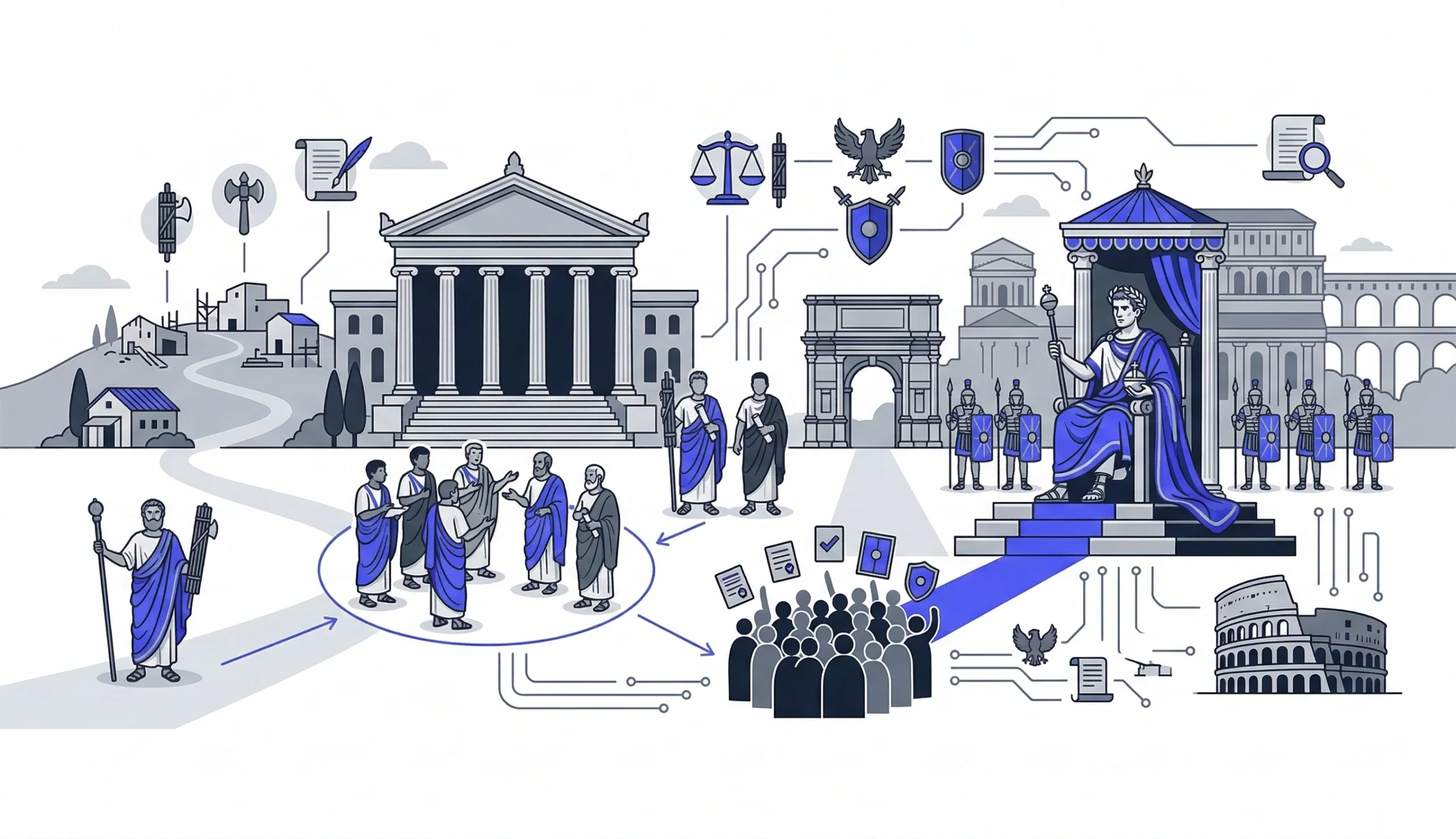
Ancient Rome had three major forms of government over time: the Roman Kingdom, the Roman Republic, and the Roman Empire. Initially ruled by kings, Rome later became a republic governed by elected officials and the Senate. Eventually, it transformed into an empire led by emperors with centralized authority.
Key Takeaways
- Ancient Rome had three main government systems: Kingdom, Republic, and Empire.
- The Roman Republic introduced elected officials and a powerful Senate.
- The Roman Empire centralized power under emperors while maintaining some republican institutions.
Roman Kingdom
The earliest Roman government where kings ruled the city-state.
Roman Republic
A system with elected leaders, a Senate, and shared political authority.
Roman Empire
An imperial system where emperors held dominant political power.
How Roman Government Evolved
Rome did not adopt a single permanent political structure. Instead, its government evolved as the city grew into a powerful state.
Initially, Rome functioned as a monarchy. Kings ruled the city, controlled the army, and served as chief religious leaders. However, Roman elites eventually overthrew the monarchy in 509 BCE.
Afterward, Rome created the Roman Republic, which lasted nearly 500 years. During this period, elected magistrates governed the state. Meanwhile, the Senate held significant influence over lawmaking and foreign policy.
Eventually, internal conflicts and civil wars weakened the republican system. As a result, Augustus established the Roman Empire in 27 BCE, concentrating power in the hands of an emperor.
The Roman Kingdom
The Roman Kingdom represents the earliest stage of Roman political organization. According to tradition, Rome had seven kings between 753 BCE and 509 BCE.
Each king held extensive authority. For example, the king commanded the army, enforced laws, and oversaw religious ceremonies. However, a council of elders known as the Senate advised the king.
Although kings ruled Rome, the monarchy did not function as a hereditary dynasty. Instead, the Senate selected new rulers.
Eventually, dissatisfaction with royal power led to the overthrow of the last king, Tarquinius Superbus. Consequently, Romans replaced the monarchy with a republic.
The Roman Republic
The Roman Republic introduced a more complex political system. Instead of a single ruler, several institutions shared authority.
Two elected officials called consuls served as the highest magistrates. Each consul governed for one year, which limited the risk of dictatorship.
Meanwhile, the Roman Senate became the central advisory body. Senators guided policies, managed finances, and shaped foreign relations.
Additionally, citizens participated through assemblies that voted on laws and elected officials. Therefore, the republic combined elements of democracy, aristocracy, and oligarchy.
However, political competition eventually produced instability. Civil wars between powerful generals ultimately ended the republican system.
The Roman Empire
The Roman Empire emerged after decades of political conflict. Augustus became the first emperor and reorganized Roman governance.
Although republican institutions still existed, emperors held ultimate authority. For instance, the emperor commanded the military, controlled taxation, and influenced legislation.
As a result, the empire became more centralized than the republic. Nevertheless, the Senate continued to operate as a prestigious political body.
Over time, emperors ruled an enormous territory that stretched across Europe, North Africa, and the Middle East.
Pros
- Republic allowed citizen participation in politics.
- Empire created strong centralized leadership.
- Roman systems influenced modern democracies.
Cons
- Republic often suffered from political corruption.
- Power struggles caused civil wars.
- Imperial rule could become authoritarian.
Comparison of Roman Government Systems
Expert Insight
Roman political systems influenced many modern governments. For example, the United States adopted several republican ideas, including elected representatives and a senate.
However, Rome also demonstrates how political systems evolve. Economic inequality, military power, and political rivalries can transform governments over time.
Frequently Asked Questions
Was Ancient Rome a democracy?
Ancient Rome had some democratic elements, especially during the Roman Republic. Citizens could vote in assemblies and elect officials. However, wealthy elites still dominated political power.
When did Rome become an empire?
Rome officially became an empire in 27 BCE, when Augustus established imperial rule after a series of civil wars.
How long did the Roman Republic last?
The Roman Republic lasted from 509 BCE to 27 BCE, making it one of the longest republican systems in ancient history.
Summary
• Ancient Rome had three main government systems
• The Roman Kingdom ruled early Rome with kings
• The Roman Republic introduced elected leadership
• The Roman Empire centralized power under emperors
• Roman political ideas influenced many modern governments