

Quick Answer
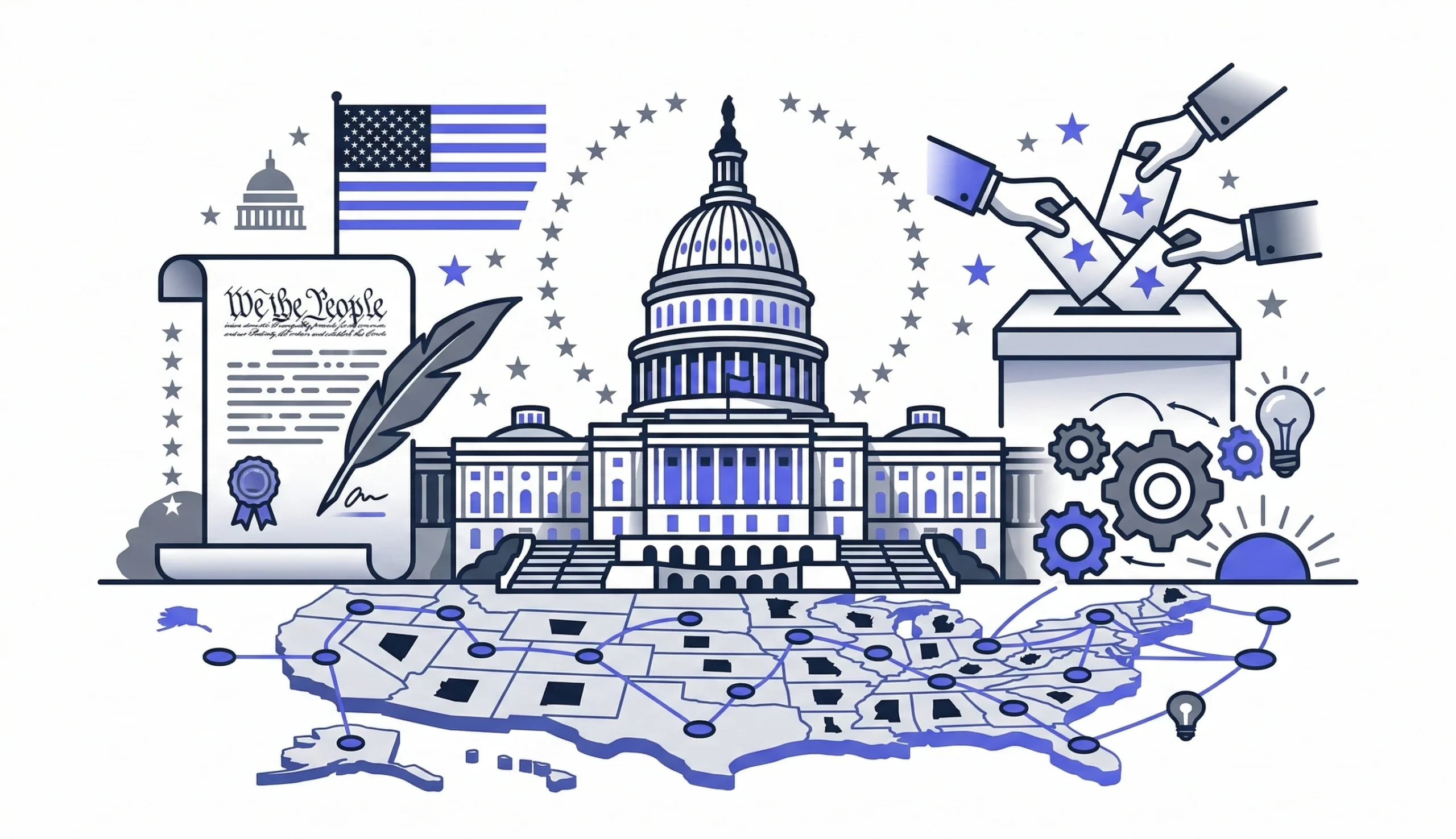
The United States has a federal constitutional republic with democratic principles. In this system, citizens elect representatives to govern, while the Constitution limits government power. Authority is also divided between national and state governments, creating a balance designed to prevent concentration of power.
Key Takeaways
- The United States operates as a federal constitutional republic.
- Citizens elect representatives who make laws and govern.
- Power is divided between federal and state governments.
- The Constitution limits government authority and protects rights.
Federal Government
Authority is divided between national and state governments.
Constitutional Republic
Leaders are elected and must follow the Constitution.
Representative Democracy
Citizens influence government through elections.
How the U.S. Government System Works
The U.S. government combines several political principles. Because of this structure, the system balances democratic participation with constitutional limits.
First, the United States uses representative democracy. Citizens vote in elections to choose leaders such as the president, senators, and representatives. As a result, public opinion influences national policy.
Second, the country operates as a constitutional republic. The Constitution establishes the framework for government and limits what leaders can do. Moreover, it protects fundamental rights like freedom of speech and due process.
Third, the system is federal. This means power is divided between the federal government and individual states. For example, states manage many local matters such as education and policing, while the federal government handles national issues like defense and foreign policy.
Together, these elements create a balanced system designed to prevent abuse of power.
The Three Branches of Government
Another essential feature of the U.S. system is the separation of powers. Government authority is divided among three branches.
Legislative Branch
Congress makes federal laws. It consists of two chambers:
- The Senate
- The House of Representatives
Because legislation must pass both chambers, the system encourages debate and compromise.
Executive Branch
The president leads the executive branch. This branch enforces laws and manages federal agencies. In addition, the president serves as commander-in-chief of the armed forces.
Judicial Branch
The judicial branch interprets laws. The Supreme Court and other federal courts ensure that laws follow the Constitution. Therefore, courts can invalidate laws that violate constitutional principles.
Advantages and Limitations of the U.S. Government System
Pros
- Protects individual rights through the Constitution
- Encourages citizen participation through elections
- Balances power across branches and states
Cons
- Decision-making can be slow
- Political gridlock may occur between branches
- Complex system can confuse voters
Comparison With Other Government Types
FAQ
Is the United States a democracy or a republic?
The United States is both. It functions as a republic with democratic elections, meaning citizens vote for representatives rather than making laws directly.
Why is the U.S. called a federal system?
Because power is shared between the national government and individual states. Each level has specific responsibilities defined by the Constitution.
Who holds the most power in the U.S. government?
No single branch holds all power. Instead, the system uses checks and balances, ensuring each branch can limit the others.
Summary
- The United States has a federal constitutional republic.
- Citizens influence government through democratic elections.
- Power is divided among federal and state governments.
- The Constitution limits government authority.
- Three branches ensure checks and balances within the system.